Minimizing Billing Gaps with Real-Time Check-Ins and Time Management

Kartik Iyer

Sergii Melnykov

Wilson Christian

Pratik Singh

Mickey Xiong
UX Research
Product Strategy
Product Design
Prototyping
Spotwork connects companies with contract workers for short-term staffing needs. Precise and accountable time tracking is foundational not only to worker payment and client billing, but also to overall trust in the platform. However, our legacy timesheet system lacked operational flexibility and oversight forcing floor managers to maintain records offline, leading to frustrating delays and manual reconciliation errors. 15% workers across all shifts would raise pay issues weekly, which rose up to 20% during busy season.
We spoke with multiple floor managers to understand their day-to-day workflows and activities, and gathered artifacts such as spreadsheets and photos of attendance sheets they used to manage check-ins. Further, I apprenticed with the finance team through an invoicing cycle to experience the process and pain-points first-hand. Here's what we found out—
Disjointed time tracking and limited real-time shift oversight led to confusion, operational inefficiency, and trust issues.
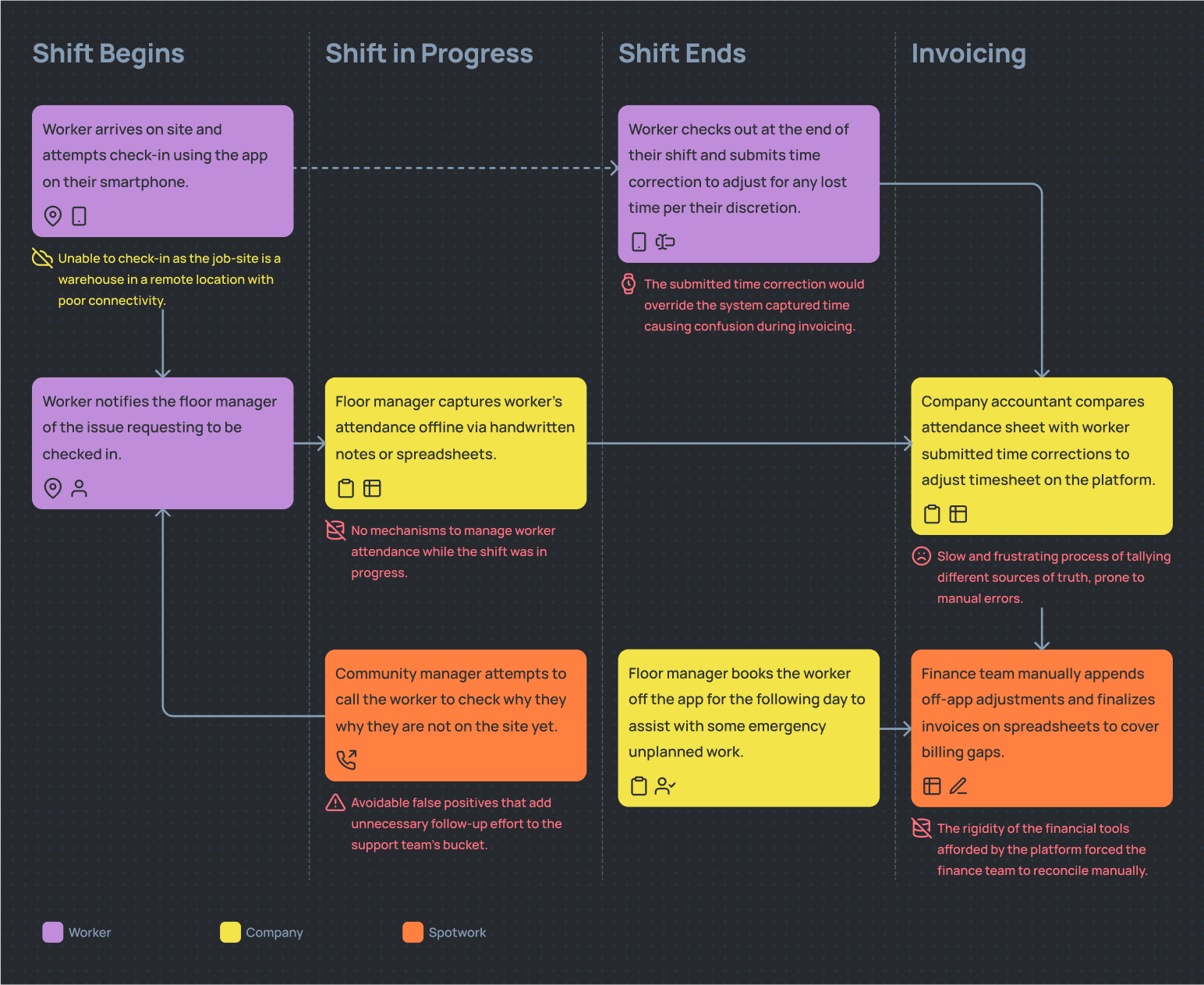
The old check-in workflow relied on manual reconciliation and overlapping time entries, often leading to disputes, manual errors, and unnecessary back-and-forth between workers, managers, and support.
1
Inflexible Shift Monitoring
Floor managers had no tools to verify or update attendance while a shift was in progress. Any adjustments had to be made after the fact, often copied from hand-written notes or spreadsheets.
2
Connectivity-Dependent Clock-In
Workers needed mobile data to check in on-site. Those in remote areas without connectivity were often unable to log time, triggering manual fixes.
3
Overlapping Time Entries Caused Disputes
The system captured check-in and check-out times automatically, but workers could override them when submitting times. There was no separation in the interface between app-captured and worker-submitted times, making it hard to verify or resolve attendance discrepancies.
4
Undocumented Off-App Shifts
Companies occasionally booked extra workers on the fly without posting shifts in the system, leading to billing gaps and compensation issues for workers.
The root causes made it clear that while the system functioned perfectly when things went as planned, it was too rigid to be able to handle anomalies. To make it more malleable under pressure, we made two attributes our north star—traceability and flexibility.
This is some text inside of a div block.
Introduce real-time oversight tools and guardrails for exception workflows to offer better operational flexibility and traceability.
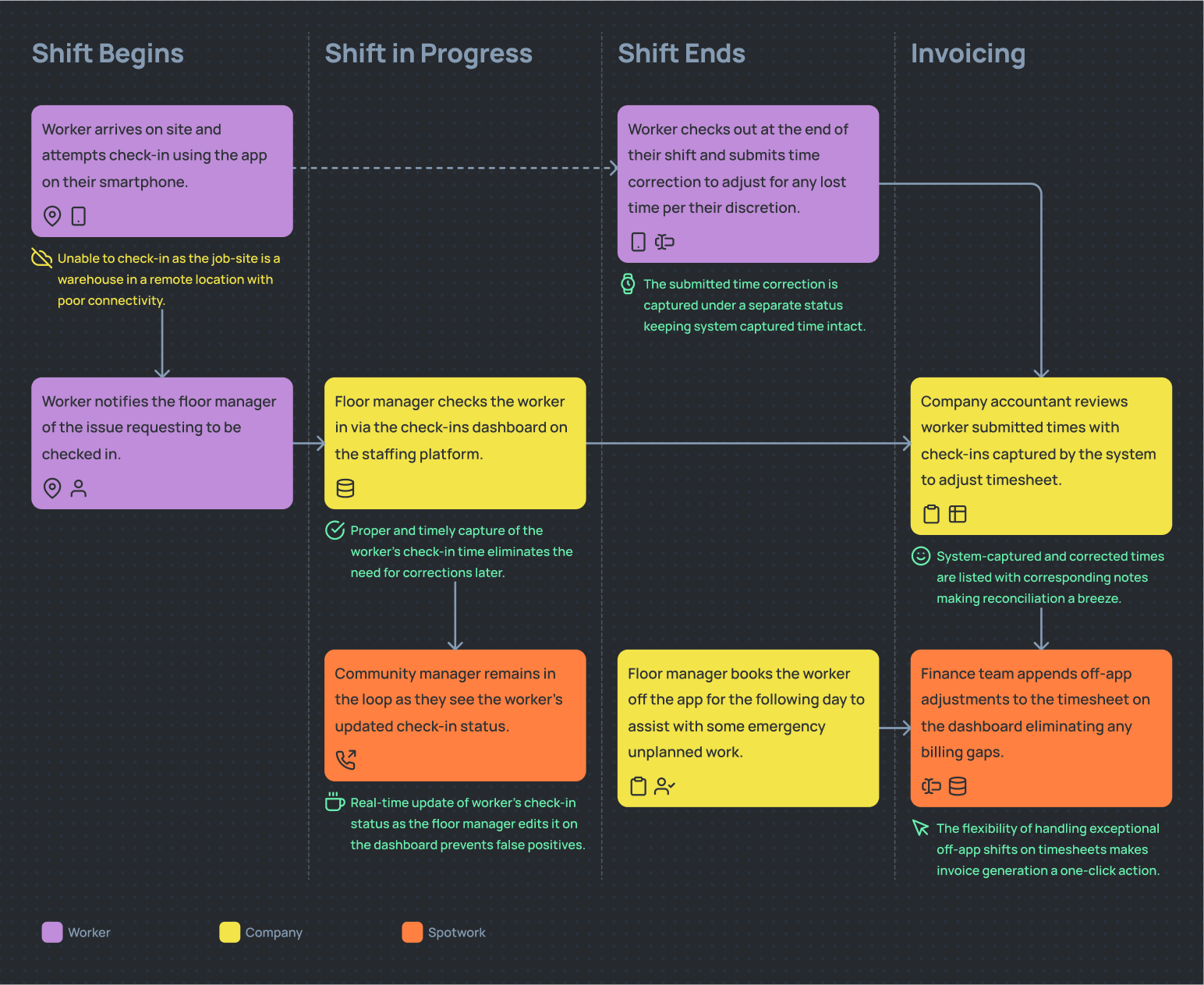
The redesigned check-in system offers real-time visibility, role-based controls, and a clear audit trail—enabling faster reconciliation, fewer disputes, and greater trust across all stakeholders.
1
Real-Time Oversight for Active Shifts
Enable floor and community managers to monitor and edit check-in activity during ongoing shifts through a dedicated view on the dashboard, reducing dependence on post-shift reconciliation.
2
Manual Overrides for Connectivity Failures
Workers unable to check in due to mobile data issues should be able to request floor managers to clock them in or out directly, maintaining data integrity in low-connectivity environments.
3
Distinguish App-Captured and Worker Submitted Times
Clearly separate system-captured check-in/out data from worker-submitted times in the UI, ensuring both are visible and traceable to reduce confusion and disputes. Worker-submitted time must be reviewed and approved to be finalized for invoice.
4
Special Timecards for Off-App Shifts
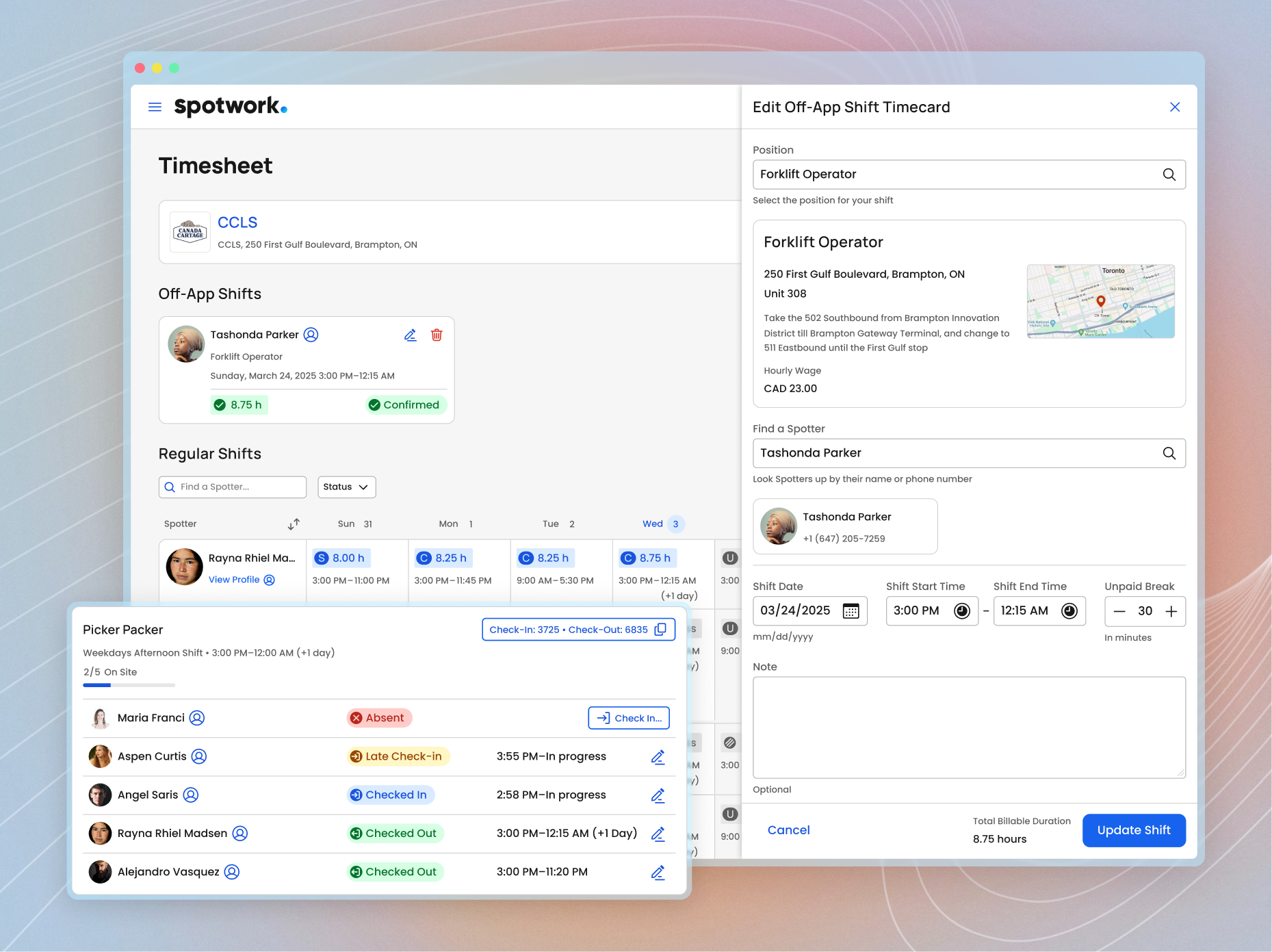
Allow finance team members to add off-app shifts manually during invoicing. Company users should be limited to view-only access, preserving billing accuracy without encouraging off-platform scheduling.
5
Centralized Logging of Manual Adjustments
All edits—whether by workers, managers, or finance—are recorded with attribution in a unified changelog, enabling full auditability across payroll and client billing processes.
With better oversight, status visibility, and accurate reconciliation of off-app shifts, the finance team reported a 20+% drop in manual corrections during invoicing.
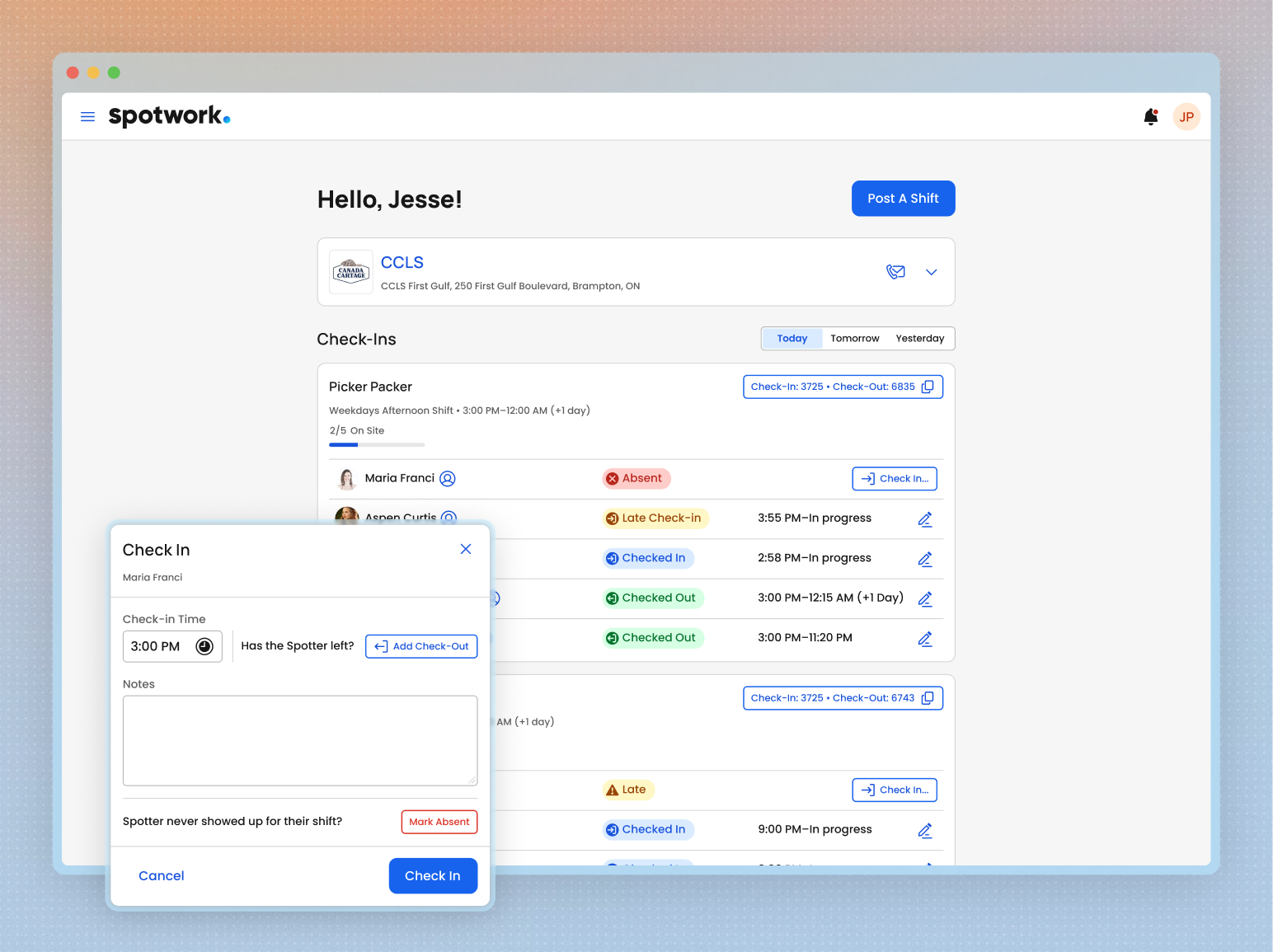
The check-ins dashboard empowers managers to track attendance in real-time and flexibly edit check-in status and time for workers while the shift is in progress.
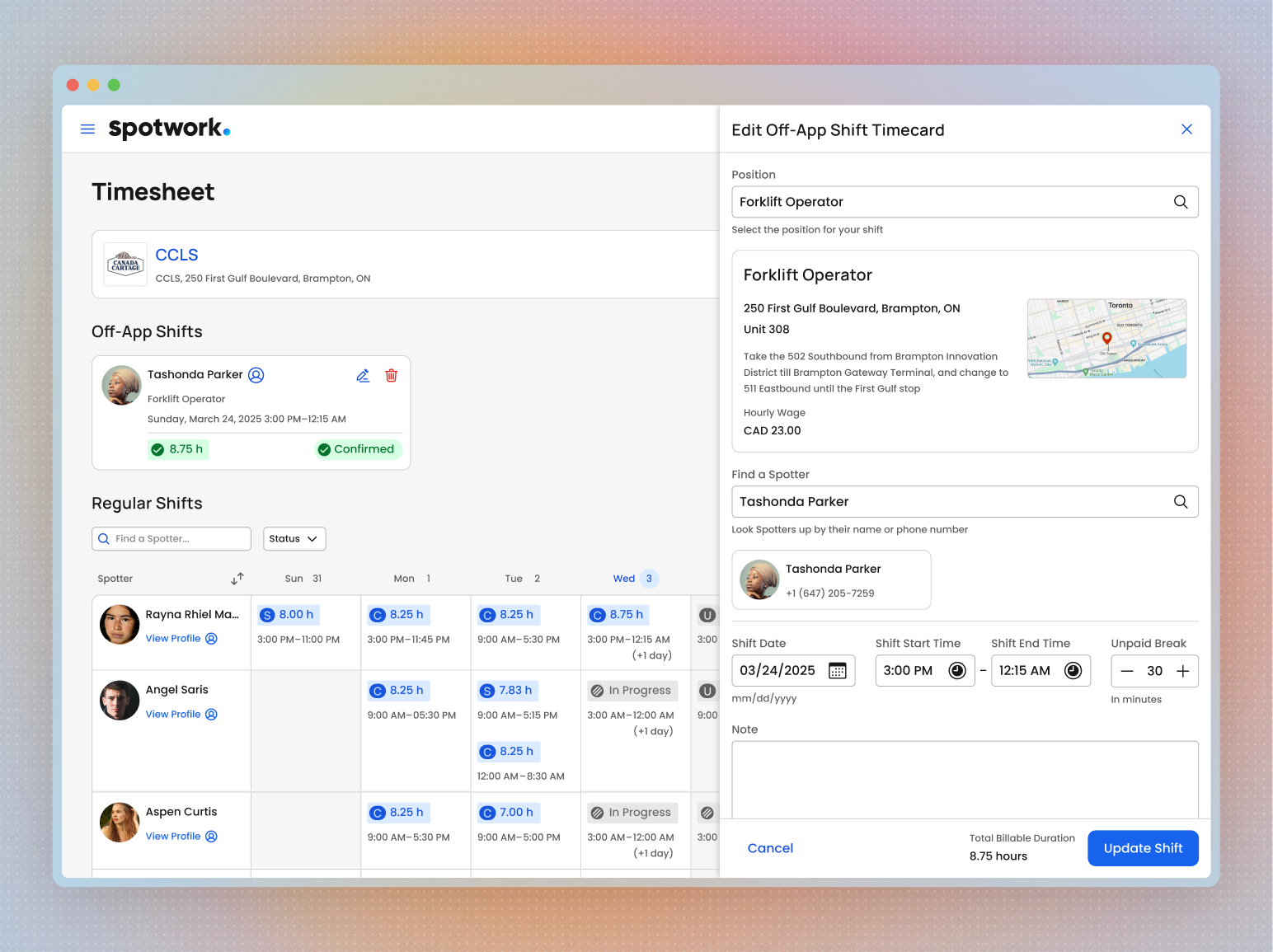
Off-app shift adjustments are handled exclusively by the finance team, ensuring accurate invoicing while preserving control and minimizing scheduling outside the platform.
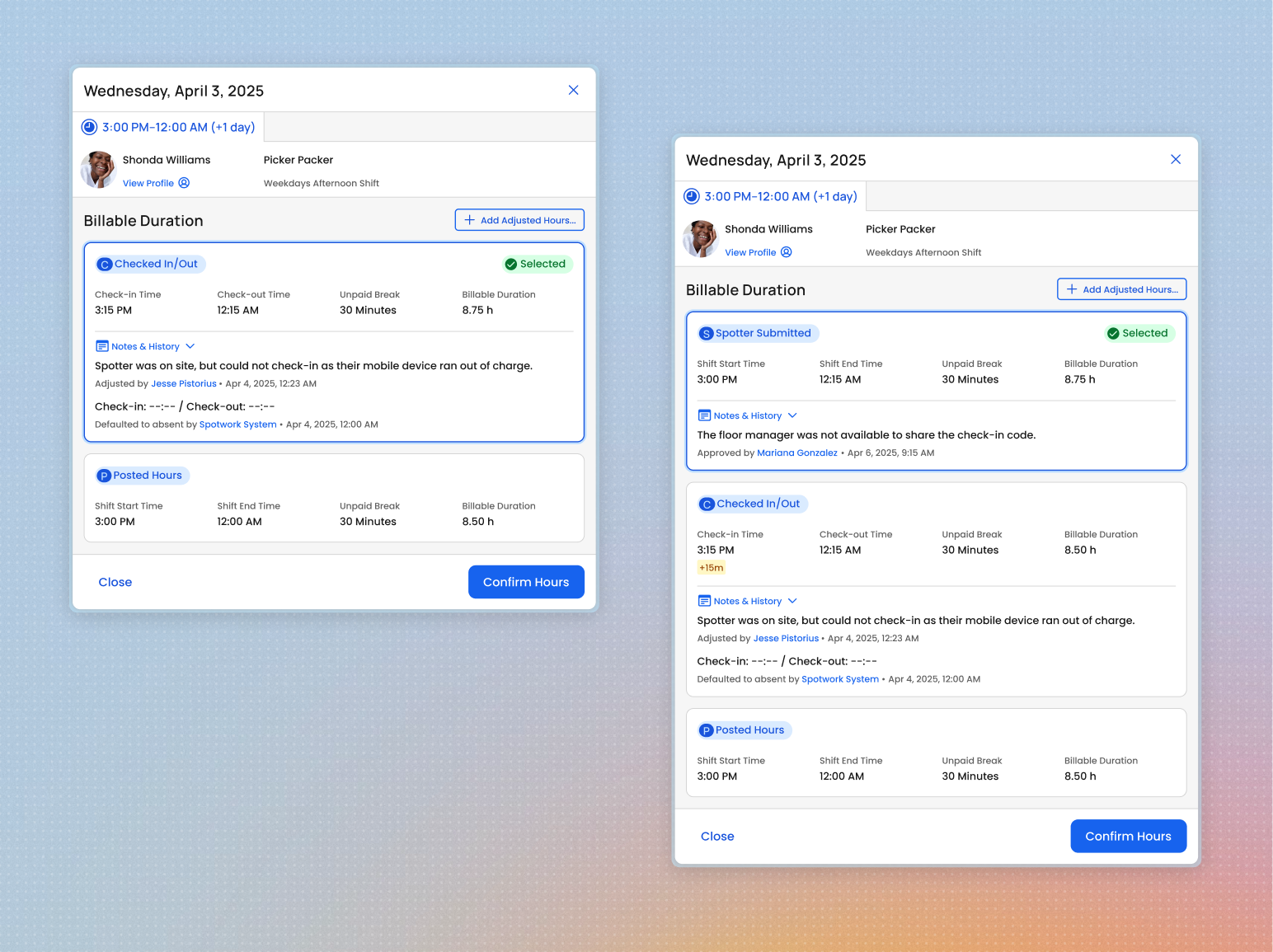
System-captured and spotter-submitted times are clearly distinguished within timecards, complete with contextual notes and edit history—making reconciliation an effortless process.
<35 tickets/week
↓ 65%
Average number of attendance dispute tickets per week
Support teams handled an average of 90 worker tickets per week related to check-in issues. After launch, this dropped to below 35 tickets per week—a whopping 65% reduction driven by improved time visibility and manager oversight.
<15 minutes/shift
↓ 50%
Average time spent by managers on shift reconciliation
Floor managers previously spent an average of 30 minutes per shift manually reconciling check-in data between spreadsheets, paper-based trackers and the platform. With real-time editing, this was reduced to under 15 minutes per shift.